
Most writers badly misunderstand how AI will affect their writing career.
Many are afraid AI will take every writing job that exists, from novelist to technical editor, destroying the very craft of writing itself and leaving in its wake an endless sea of cut-rate generated text that serves no one. Some of these writers are starting movements to ethically object to AI, while others are giving up in despair and switching careers entirely.
Others are unconcerned and sure that AI is simply a fad that will go as quickly as it came. Some are convinced that AI will never be able to replicate human creativity or quality. Some see AI as just another Web 3.0 or Silicon Valley bubble. Some think the economy support or the government won’t back wide AI adoption.
The problem with these perspectives is that they all over-focus on only one aspect of AI. Instead of looking at the whole economy, writing as a craft, and AI as a technology, they cherry-pick one or two variables of the situation and use that variable to draw an entire conclusion.
Let’s look at each of these variables in the context of the whole to arrive at a more educated conclusion about AI's role in the writing economy.
Can AI replace human writers? The answer may surprise you
Critics usually frame this as a yes/no question or sometimes tackle it as a mathematical proposition in which someone calculates the variance in AI-created works and tries to measure whether this can “replicate” “human creativity,” but these responses all miss the real point.
From a certain sentimental point of view, AI will undoubtedly never replace humans. Even if you can train an AI to generate impressionist paintings like Van Gogh’s, it will never produce a genuine Van Gogh, that masterpiece which belies his unique and magnificent way of seeing the world. AI will only ever produce superficial approximations of such things.
But that is not the point. Copywriters are rarely ever hired to create masterpieces. A handful of writers make six- and seven-figure salaries writing masterpieces, but they are the extreme minority. For every wealthy writer toiling in their writing nook, nine hundred and ninety-nine writers are banging out emails, brochures, and flyers for clients big and small. These entities care less about bringing a specific vision to life than they do producing something that will drive enough revenue for the lowest cost possible.
Critics who get hung up on whether AI is capable of “real creativity” miss the point that it doesn’t matter. AI doesn’t need to create anything new to be able to do this work. Any creative professional who does this work now can tell you it’s less about being a genius artist and more about replicating effective patterns in the marketplace. And ChatGPT is very good at replicating patterns.
My career itself stands as evidence. Here is how I manage my workload in my career:
- For my original creative work, Medium and elsewhere, I don’t heavily use ChatGPT. Sometimes, I use it to develop ideas, but nothing it generates ever directly makes it into my articles. It will never replace me in this regard because it cannot replace me; even a custom instance trained on my body of work fails to generate text that is the same as what I want to say right now. AI may produce good writing, but it doesn’t produce my writing.
- However, for my clients, ChatGPT does all of my initial drafting. I merely solicit requirements, feed them into ChatGPT like a data processor, lightly edit the output with the client, and format the result for web and print deployment. The only time I type something by hand at work anymore is when I develop instructions for custom GPTs, which I do for all my clients to make sure my AI is capturing their unique brand voice.
Lots of the conversation about AI taking writers’ jobs has been fears that AI will replace, say, bestselling novelists. AI will no more replace a bestselling novelist than Ikea has replaced handcrafted furniture. There will always be a market for the boutique masterpiece. What AI will replace is the entry-level copywriter, replacing inexperienced team members and bottom-dollar freelancers with a ChatGPT Enterprise license.
Recent data suggests the market is already feeling the impact:
Freelance jobs that require basic writing, coding or translation are disappearing across postings on job board Upwork, said Kelly Monahan, managing director of the company’s Research Institute.
Her findings echo those of more than a dozen other researchers at institutions including Harvard Business School, Washington University in St. Louis and the University of Hong Kong. They have found that since the debut of ChatGPT and other generative AI models, the number of freelance jobs posted on Upwork, Fiverr and related platforms, in the areas in which generative AI excels, have dropped by as much as 21%.
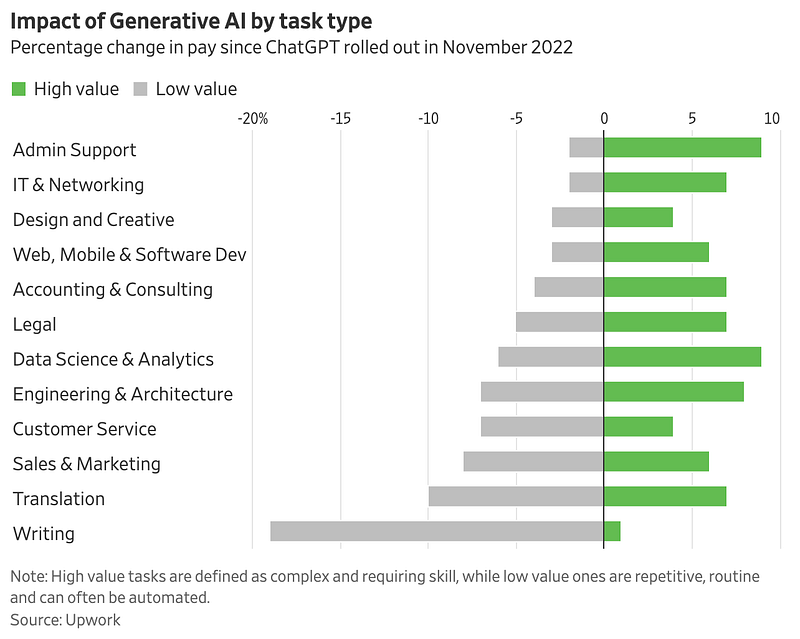 Image source: AI Doesn’t Kill Jobs? Tell That to Freelancers, WSJ
AI Doesn’t Kill Jobs? Tell That to Freelancers
Christopher Mims, The Wall Street Journal
The jobs that remain will change
Unlike the freelancers on Upwork, my leads have not gone down in the last two years. Quite the opposite; I’m enjoying more demand than ever. By integrating AI into my professional workflow, I’ve completely changed the way I serve clients.
Here is my AI production process:
- I solicit content requirements and brand guidelines. Sometimes, my clients have already had these documents prepared by a previous brand design freelancer or digital marketing agency, and sometimes, we have to put our heads together to make these ourselves.
- I sign up for an OpenAI account for my client and create a custom GPT for them. In the instructions for the custom GPT, I paste the content requirements and brand guidelines from earlier. Sometimes, I need to make multiple custom GPTs, one for copywriting flyers and articles, one for internal communications, one for social media, one for newsletters, etc.
- Instead of drafting content by hand for all subsequent deliverables, I generate drafts using this custom GPT. When clients provide feedback, instead of directly editing the document, I use their feedback to modify the instructions for the GPT and re-generate content. Within four or five review cycles, the GPT is tuned finely enough to generate content for my client.
- Voila! I can now generate client deliverables in as little as ten minutes. These deliverables do require human editing on my part, but the hard work of the first draft has been replaced by the custom GPT.
This process has changed my career. It now takes me a fraction of the time to draft deliverables as it did before. The most laborious parts of my job duties are generating products for delivery or posting deliverables live on websites, parts of the job that used to be merely finishing touches. It’s tripled my capacity to take on more work for my clients, more clients, or even take afternoons off.
It works great for typical clients but even better for clients with specific technical, legal, and regulatory compliance requirements, as custom GPTs follow their compliance mandates to the letter without my having to spend six months to 1 year becoming a copywriting expert for that industry.
I’m not the only one benefitting from the shift in technology. In the same Wall Street Journal article, Mims writes:
As in other periods of rapid adoption of automation, there are those who benefit from the shift. Freelancers who become more productive when using AI, but can’t yet be replaced by it, such as data science and IT, earn on average 40% more, says a spokeswoman for Upwork.
And then there are the freelancers who report that demand for their work is up because, at least in their more demanding and specialized roles, AI isn’t living up to the hype.
Not long after ChatGPT debuted in November 2022, David Erik Nelson, a freelance sales and marketing copywriter in Ann Arbor, Mich., saw a jump in inquiries.
“I was picking up new clients whose specific complaint was that their previous vendor had been giving them AI-generated content, and hadn’t been straightforward about it,” says Nelson. The AI had produced smooth prose intended for sales materials, but it was so generic, and often wrong, that it wasn’t about to convince people making six- and seven-figure purchasing decisions.
“The marketing people think it looks fine,” says Nelson, “but then you hand it to someone who actually knows something about industrial fluid purification, and they’re like, ‘This is word salad.’”
AI Doesn’t Kill Jobs? Tell That to Freelancers
Christopher Mims, The Wall Street Journal
This echoes my experience. When new clients come to me, they all voice the same complaint: “We need good content for our specialty industry, and neither entry-level copywriters nor AI tools are getting the job done.” It takes someone with both an understanding of how to train an LLM model and copywriting skills to produce a model that can generate content even close to these clients’ specifications. (Even then, human editing is always required).
Copywriters proficient with AI are seeing their careers explode as the media elevates them to a new level of copywriting professionals.
As Copywriter Alex Napier said on Reddit:
I work closely with (startups) and I’ve been invited to present at a conference regarding the impact of AI on copywriting.
I don’t have any worries about losing work anytime soon. I’ve made more money in the first four months of this year than the whole of 2023.
How copywriters can prepare their careers for the future
A self-explanatory first step is to familiarize yourself with AI technology. Make an OpenAI account and start using ChatGPT. For bonus points, use competitors like Google Gemini to understand their strengths and weaknesses. Use them to produce personal and professional work and assess its strengths and weaknesses.
This recommendation never fails to change the lives of my colleagues when I make it. People who were formerly convinced AI “could never replace them” were astonished to find that AI could replace labor-intensive parts of their workday with a five-minute prompt, such as the historian I trained on using ChatGPT to generate paper outlines and develop ideas. Friends convinced AI was a fad were astonished to find ChatGPT shaved hours off their workday by automating formerly tedious tasks once I showed them how to use it. The notion that AI is anything less than a game-changer is laughable to the people who use it daily.
However, weaknesses in the basic models will quickly become apparent to you. ChatGPT has its own voice that it sticks to regardless of how often you prompt it to do otherwise. Once you reach that point, learn how to craft instructions and upload training material for custom LLMs, such as ChatGPT’s custom GPT feature.
At this point, you may feel divorced from your original intention to make a living writing. Is this even writing? I initially felt that way, but with time, I’ve learned to enjoy this way of working. It utilizes all my copywriting and digital marketing knowledge and skills. Not having to write by hand during the day gives me much more time to write for my Medium blog, personal fiction projects, and other artistic endeavors. Far from sucking the joy out of my life, it’s given me back loads of time to pursue these passions of my heart.
In Conclusion
There are many aspects of AI’s influence on copywriting I didn’t even begin to touch on in this article, such as the ethics of using AI, copyright law issues, government funding, and so on. But these concerns don’t worry me for one reason: AI is a hugely profitable tool. In our capitalist economy, profitable tools for those at the top get the resources and funding they need to succeed, regardless of the cost. Does anyone remember 2008, or am I getting old?
All in all, it pains me whenever I see an article or read a post from a writer who claims “AI is all hype” or that “AI cannot replace humans.” These writers fail to understand the types of writing that AI is replacing and the underlying motivations of businesses hiring writers. AI will replace many human copywriter jobs, and the remaining copywriters will use AI as an essential tool.
If you are a freelance copywriter who doesn’t want to be left behind in the marketplace, there’s still plenty of time for you to catch up. These tools are less than five years old, and most people are still woefully unaware of them.
If you have any more questions, would like a more detailed explanation of how I use ChatGPT in my work, or have any thoughts about what we’ve discussed here, leave a comment below. I’m interested in writing more about this topic if you are interested in reading more about it.